

Idiosyncratic Heart
the magnetism of giving it all away


In the midst of our fascination with and resistance to Large Language Models (AI), it strikes me that we long even more for the awkward human voice. Like all major technological advancements, there’s a tension between our thirst for optimization and anxiety about the human and more-than-human cost.
Whether you’re an early adopter of AI, intrigued by the possibilities of relating subject to subject or vehemently opposed to how it scrapes the earth like a bottom trawler on the ocean floor, resistance to this technology speaks to a bigger human longing.
Just as Plato worried that writing would limit human exchange, like a painting, “preserve[s] a solemn silence”, many of us are worried that AI will compromise the trembling awkwardness of human expression. We’re concerned that art, books, philosophy and ideas will become flattened into efficient patterns, destroying livelihoods and watersheds along the way. Our resistance highlights (even here on Substack) that being human with one another is what counts and has nothing to do with optimization.
What charms me most about our resistance to AI, aside from rising carbon emissions at a time when we need to be carbon negative (h/t Dr. John England), is that our human hearts are genuinely looking for the imperfect, the idiosyncratic in each other.
*
A person who magnifies the imperfect and idiosyncratic is the Irish bard, the late Glen Hansard. A street busker of abundant talent and lead-singer of The Frames, he made room for imperfect intimacy, with anyone, almost anytime through the magic of music.
Fame didn’t distract or distance him from street folk, pub-goers or awkward up and coming musicians. He had a regular gig at his local pub, pulled strangers up on stage to sing, and encouraged new artists with a kind of feral soul-optimism. Once he invited a large audience up on stage so they could all escape a sudden, cold downpour.
While its easy to gloss over the contradictions of any given life, I’m touched by the abundance of stories that share how others were transformed by his willingness to exchange passionate wails and whispers of the human heart.
*
My enchantment with this remarkable artist turns around the question of what actually moves and brings humans closer together. In contrast to what we’ve been conditioned to believe by a multi-billion dollar wellness and self-improvement industry, the relentless pressure to improve, perfect and optimize just aren’t it.
What we long for and are moved by is what’s uniquely human. By art and song. Bard-traveling, heart-wrenching trying. Our vulnerable and invitational, soft-sweatered ballads of incompletion.
We all have our sweaty ways of wrestling with some version of what we think we should do and what calls us. For me, this is currently in the form of a difficult puzzle or koan. As I’ve shared in Season 4 of my podcast, Tension of Emergence and preludes to my current book-in-progress, The World Doesn’t Need Your Saving, I struggle between two polarities– saving and savouring– when I try to make sense of my role at this cultural moment.
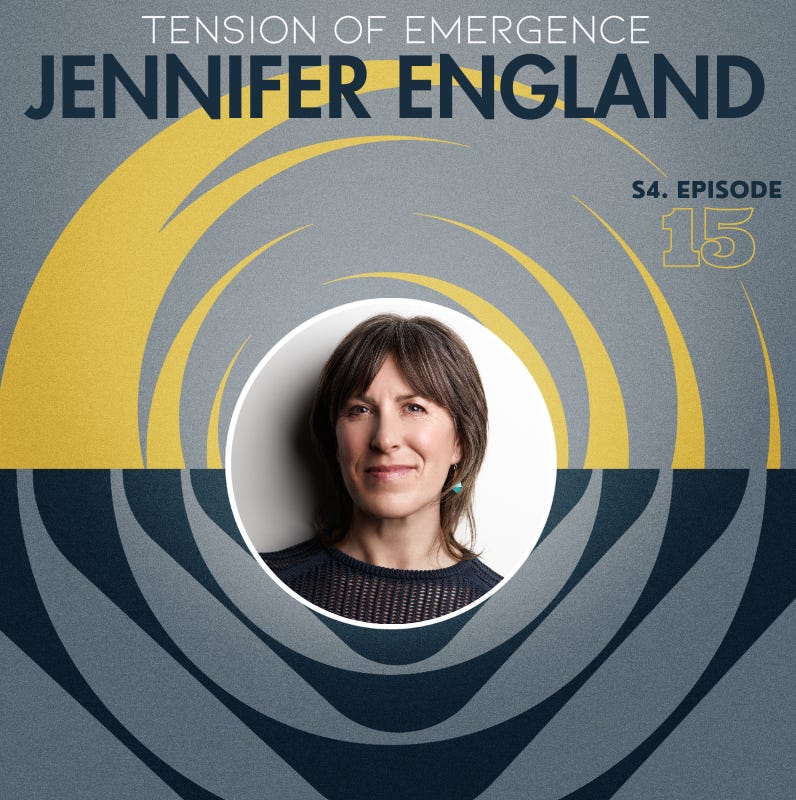
Today, I want to give you something. It’s my small imperfect offering is the season’s finale. I don’t offer you a tidy conclusion nor a soft decrescendo. Instead, this 30 minute episode is like a small, half-lit stage that shows what’s moving and working my heart in real time– including a challenging real-life situation that strikes at the heart of my saving/savouring koan.
What I deeply appreciate from people like Glen Hansard, and you reading here with me, is our passionate trying. The unabashed, doubt-filled angst to give all our imperfect offerings away. To somehow trust in the creative potential that comes from our idiosyncratic hearts beating with grief and joy, no matter how incomplete or lost.
I’m encouraged, through the ironic distance between me and someone I’ll never meet, that we can savour the heart-break of it all (including a life gone too soon) while doing our messy part to save what we love in this briefly gorgeous planet.
LISTEN HERE TO THE SEASON FINALE
AUDIO PAIRINGS 🎧
Pair this reflection with one of these beautiful idiosyncratic human encounters:
🎧 Falling Slowly by Glen Hansard and Markéta Irglová
🎧 Unlearning Perfectionism with Rachel Blackman and Jennifer England
🎧 Give it Away (A Practice) with Jennifer England
Dear Jennifer,
Thank you for this essay. Like so much of your writing, it stayed with me long after I finished reading it.
I found myself nodding in agreement as you described our longing for the awkward, idiosyncratic human voice. I share your concern that a culture obsessed with optimization can lose sight of what actually draws us toward one another. The trembling, unfinished places are often where the deepest connection is found.
At the same time, I wanted to offer another perspective born from my own experience.
Over the past several years, I have been advocating for my son. That advocacy has required navigating educational, medical, and legal systems while reading thousands of pages of reports, policies, legislation, research, and correspondence. Like many parents, I did not have access to advocates, lawyers, or researchers. I had determination, but not the resources that many institutions take for granted.
AI became, for me, not a replacement for thinking, but an equalizer. It didn’t tell me what mattered. It couldn’t know my son. It couldn’t discern the gap between institutional claims that his needs were being met and the reality I had witnessed over years of raising him. Those judgments remained deeply and irreducibly human.
What it could do was help me organize complexity, clarify my thinking, synthesize information, and express ideas with greater precision. It gave me access to capabilities that would otherwise have required expertise or financial resources beyond my reach.
The advocacy, the grief, the love, the discernment, the persistence, all of those remained profoundly human. The tool simply helped me carry a weight that had become too great for one person alone.
Reading your essay, I wondered whether there is another story to tell alongside the one about optimization. Perhaps the question is not the tool itself, but how we choose to relate to it. Like any powerful technology, AI can be used in ways that diminish our humanity or in ways that expand it. I think of the growing work in human-centred, trustworthy AI, which asks not simply whether AI should be used, but how it can be designed and governed to strengthen human agency, equity, and relationships. That feels like a profoundly human question.
Your essay ends with the hope that we might “do our messy part to save what we love.” That line resonated deeply with me. I don’t see AI as being in opposition to that hope. Used wisely, I think it can sometimes help ordinary people do exactly that.
Thank you for continuing to write in ways that invite reflection rather than certainty. I appreciate your willingness to hold tensions instead of resolving them too quickly. This essay has become one more tension I will continue to carry with me.
With gratitude,
Jess